
Leopard Behavior Jhalana: The 2026 Ethology Guide
Understanding Leopard Behavior Jhalana is the single most important factor that separates a lucky tourist from a skilled observer. To the uninitiated, a leopard is simply a beautiful cat that sleeps, walks, and hunts. But to the seasoned naturalist visiting Jaipur in 2026, the Leopard Behavior Jhalana exhibits is a fascinating evolutionary anomaly.
Confined to a 20-square-kilometer island of ancient Aravalli forest and surrounded by a metropolis of 4 million people, these cats have rewritten the rulebook of their species. They have adapted their social structures, hunting times, and even their vocalizations to fit the rhythm of the city. If you want to predict a hunt before it happens or identify a mating pair by sound alone, you must first decode the unique patterns of Leopard Behavior Jhalana. This guide is your definitive textbook to the secret life of the urban ghost.
1. The “Glass Wall”: Unique Leopard Behavior Jhalana
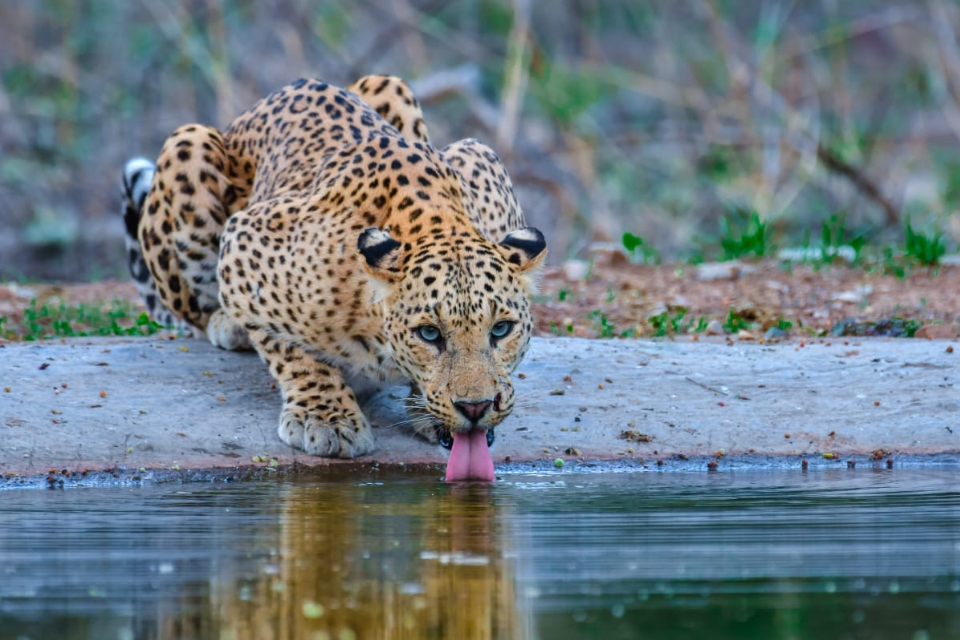
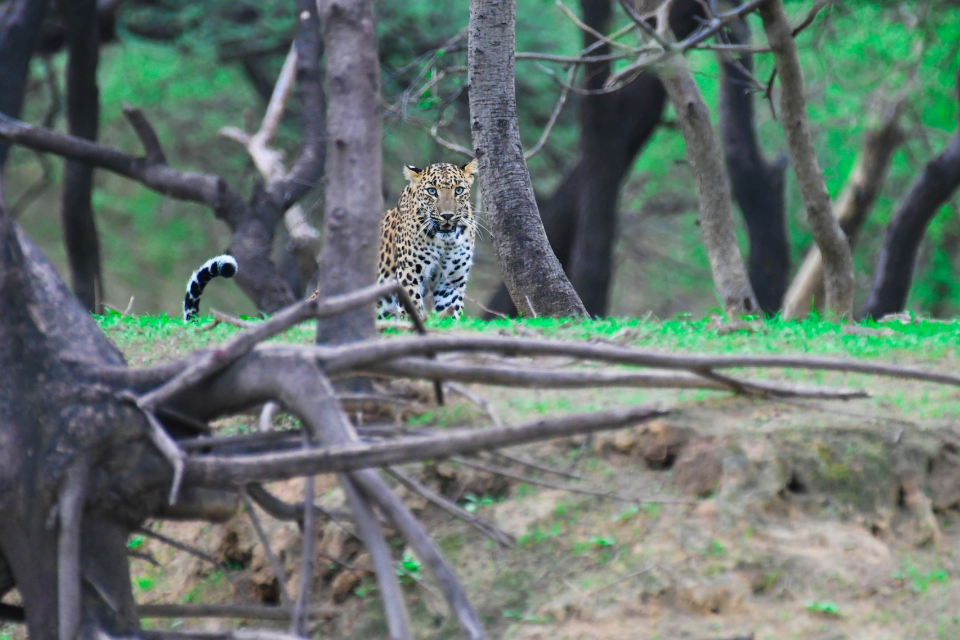
The most striking aspect of Leopard Behavior Jhalana is a psychological adaptation known as the “Glass Wall” phenomenon. In most wild reserves like Kabini or Satpura, a leopard is a phantom—seen for mere seconds before dissolving into the green abyss. In Jhalana, they exhibit a level of habituation that is rare in the animal kingdom.
Interpreting Boldness in Jhalana Leopards
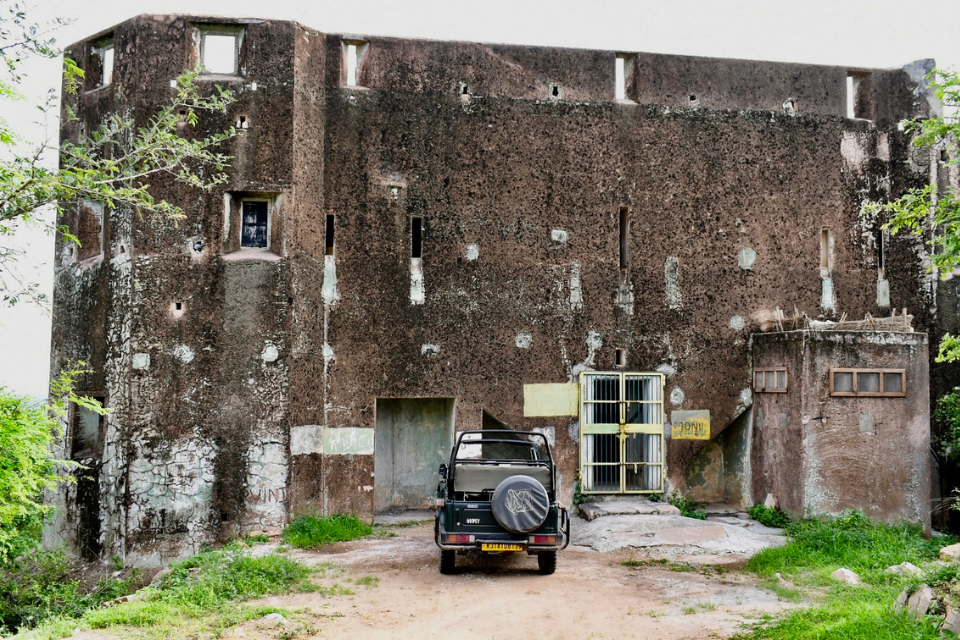
Biologists studying Leopard Behavior Jhalana have noted that these cats have learned to categorize safari vehicles not as threats, and certainly not as prey, but as “neutral biological noise.” To a Jhalana leopard, a jeep is akin to a large, moving rock. This specific aspect of Leopard Behavior Jhalana allows for intimate observations of vulnerable moments—grooming, nursing, and even mating—often within 10 meters of the track.
However, it is critical to understand that this boldness is not tameness. It is a calculated indifference. The moment a human silhouette breaks the shape of the vehicle (by stepping out or standing on the bonnet), the “neutral object” equation collapses. The cat’s demeanor shifts instantly from indifference to defensive aggression, a sharp reminder that Leopard Behavior Jhalana is still governed by the instincts of an apex predator.
2. Territorial Dynamics and Leopard Behavior Jhalana
In a high-density reserve, Leopard Behavior Jhalana is defined by intense, often violent, territorial pressure. With over 40 leopards sharing this compact space in 2026, the social dynamics are a pressure cooker.
The “Time-Share” System
In larger parks, a dominant male leopard’s territory might cover 40 to 50 square kilometers. In contrast, Leopard Behavior Jhalana dictates that a dominant male (like the current ruler of Zone 1) might hold a territory of only 5 to 8 square kilometers. This forces territories to overlap significantly, creating a unique “Time-Share” system. Sub-adult males often use the same paths as the dominant male but navigate them at different times of the day to avoid conflict.
Scent Marking and Boundary Patrols
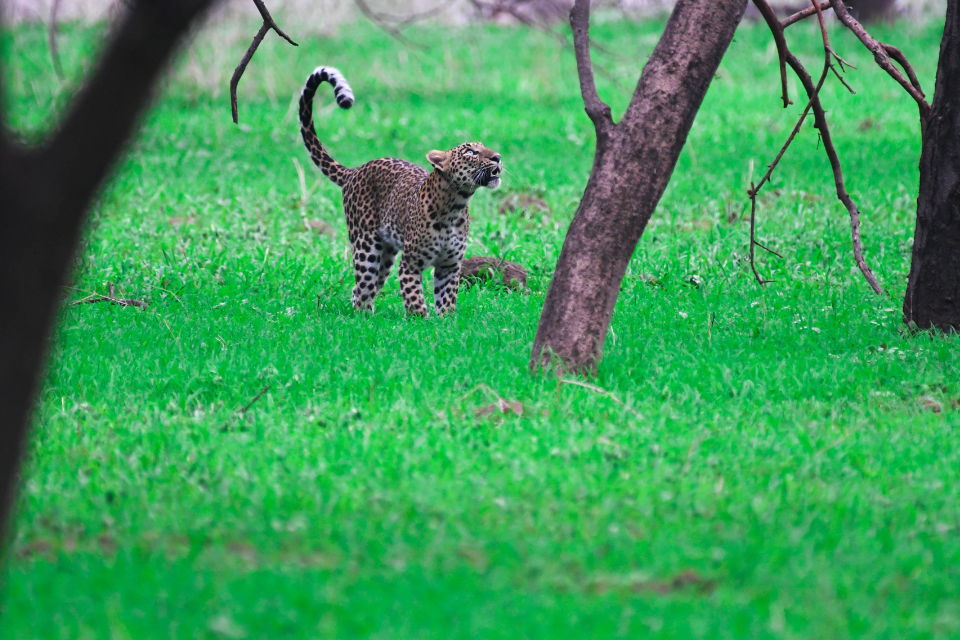
Maintaining these small, high-value territories requires constant energy. You will frequently observe scent marking and “scraping”—classic signs of Leopard Behavior Jhalana. By spraying urine on high bushes (at nose height for other cats) and scraping the ground with their hind legs, they leave a “Not Allowed” sign. Furthermore, in the early mornings of winter, the valley echoes with the “sawing” call. This vocal boundary patrol is a crucial part of Leopard Behavior Jhalana, allowing males to announce their fitness and lung capacity to rivals without risking a physical fight.
3. Hunting Strategies: Adapting Leopard Behavior Jhalana
The diet of these cats has altered their hunting methods. Leopard Behavior Jhalana has evolved to include “Zero-Distance Ambush” tactics suited for the dense Dhok forest and the unique prey base of the area.
The “Zero-Distance” Ambush
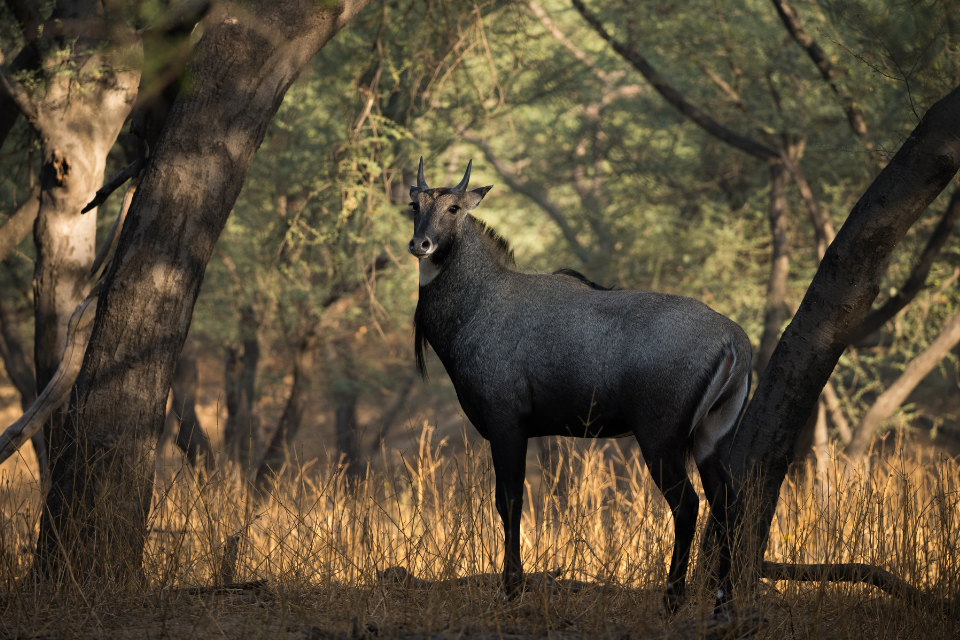
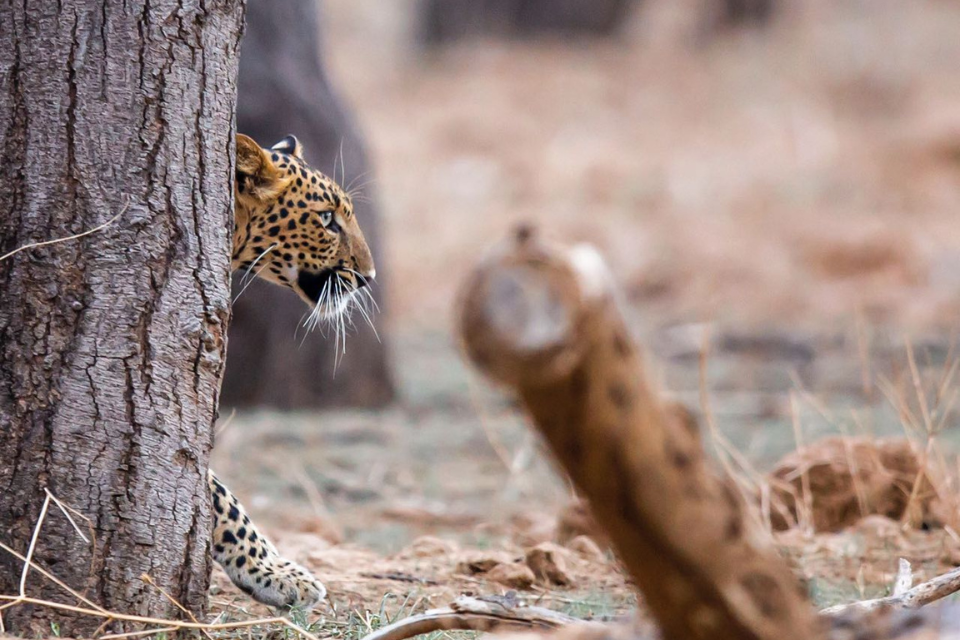
Unlike a tiger that might use brute force, Leopard Behavior Jhalana relies on extreme stealth. They utilize the grey quartzite rocks to blend in perfectly, remaining motionless for hours. This allows prey like Blue Bulls (Nilgai) to walk within 5 feet before the cat launches an explosive attack. This energy-efficient method is a direct adaptation to the hot, arid environment of Rajasthan.
The “Vertical Hunt” Technique
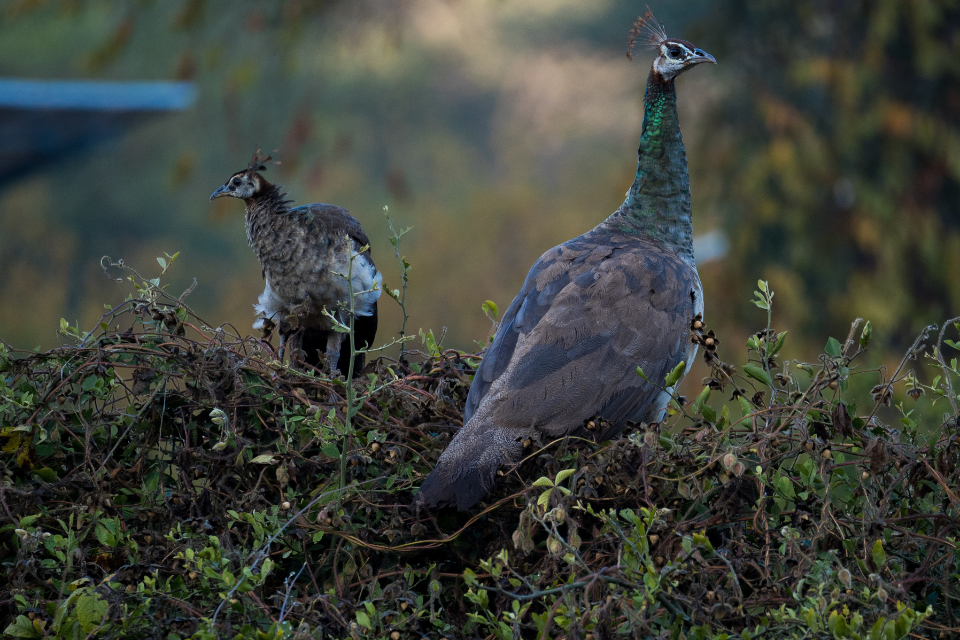
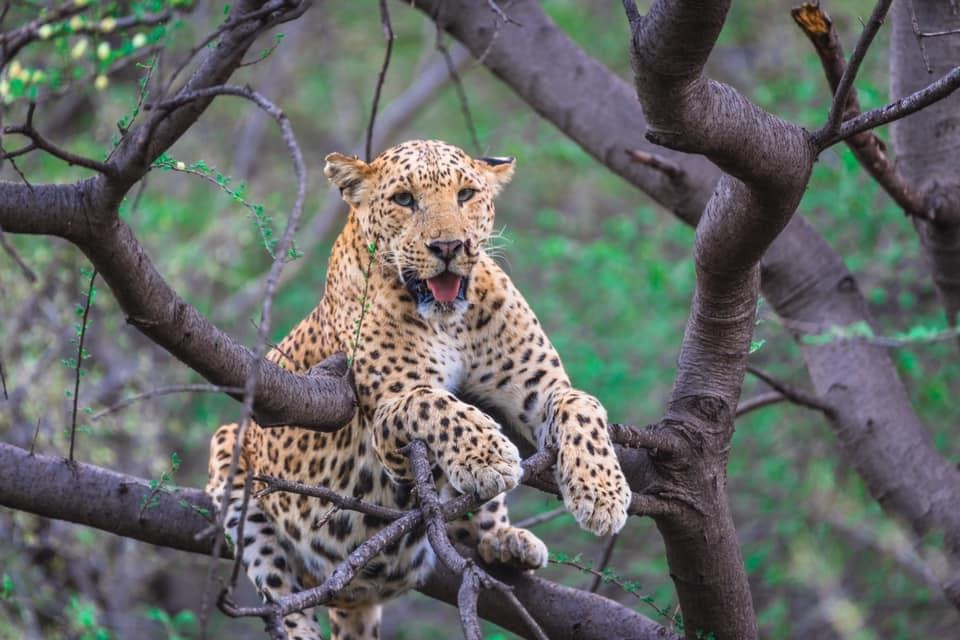
One of the most unique aspects of Leopard Behavior Jhalana in 2026 is the specialization in hunting peafowl. Jhalana has a massive density of peacocks, and the leopards have responded. Unlike their rural cousins, Jhalana leopards frequently scale trees to flush out roosting birds at twilight. Watching a 60kg cat leap 15 feet into the canopy to snatch a bird mid-flight is a prime example of the athletic adaptation central to Leopard Behavior Jhalana.
4. Mating Signals in Leopard Behavior Jhalana
Leopards are famously solitary, coming together only to mate. If you visit in winter (November to January), you may witness the noisy courtship rituals that define reproductive Leopard Behavior Jhalana.
The Female’s Role in Jhalana
Contrary to the “aggressive male” trope, Leopard Behavior Jhalana dictates that the female initiates courtship. When in estrus, she becomes restless. She uses specific “chuffing” vocalizations and aggressive scent marking to attract a male. Once a pair is formed, they stay together for 3 to 5 days. This is the only time you will see two adult leopards sitting side-by-side without aggression. The mating process is frequent (every 15-20 minutes) and is often accompanied by aggressive growling from the female immediately after copulation. This tension is a hallmark of the social complexity within Leopard Behavior Jhalana.
5. Cub Rearing and Leopard Behavior Jhalana
The geology of the Aravallis fundamentally shapes the maternal Leopard Behavior Jhalana. The reserve is riddled with deep crevices and quartzite caves that serve as the perfect nursery.
The “Cave Phase”
Mother leopards in Jhalana are hyper-vigilant. A key trait of maternal Leopard Behavior Jhalana is keeping cubs hidden in deep caves (often near the Kali Mata temple area) for the first 8 to 12 weeks. If you see a female walking swiftly and ignoring prey, she is likely returning to the den. Ethical tracking of Leopard Behavior Jhalana requires giving these mothers ample space.
The “Tree Training” Phase
Once the cubs are 4 months old, a distinct trait of Leopard Behavior Jhalana emerges: the use of Juliflora and Acacia trees as training grounds. Mothers use these trees to keep cubs safe from hyenas and rival males. You will often see the mother sleeping at the base of a tree while the cubs practice climbing above—a survival strategy that is central to the reproductive success and unique Leopard Behavior Jhalana patterns.
6. Interspecies Conflict: Hyenas vs. Leopard Behavior Jhalana
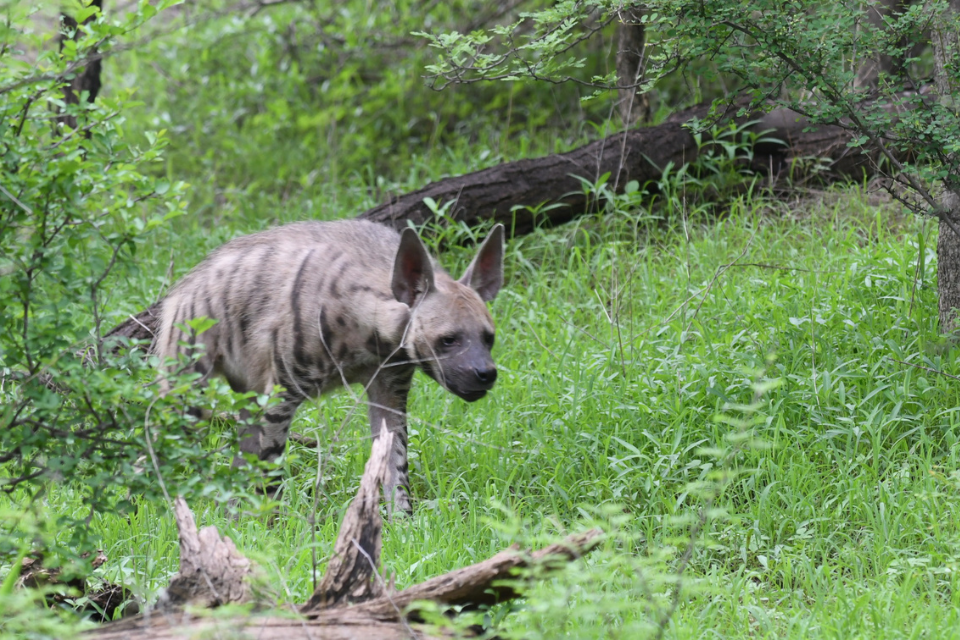
The relationship between the Leopard and the Striped Hyena is not predator-prey, but a war of attrition. This rivalry is a major driver of Leopard Behavior Jhalana.
The “Hoisting” Adaptation
Hyenas are larger and possess a stronger jaw-lock, often trailing hunting leopards to steal their meals (kleptoparasitism). To counter this, Leopard Behavior Jhalana involves a high frequency of hoisting kills into trees. If you see a kill on the ground, the leopard will be nervous and eat rapidly; if it is in a tree, the leopard will be relaxed. This positioning is a classic indicator of stress levels in Leopard Behavior Jhalana.
7. Olfactory Communication: The Flehmen Response
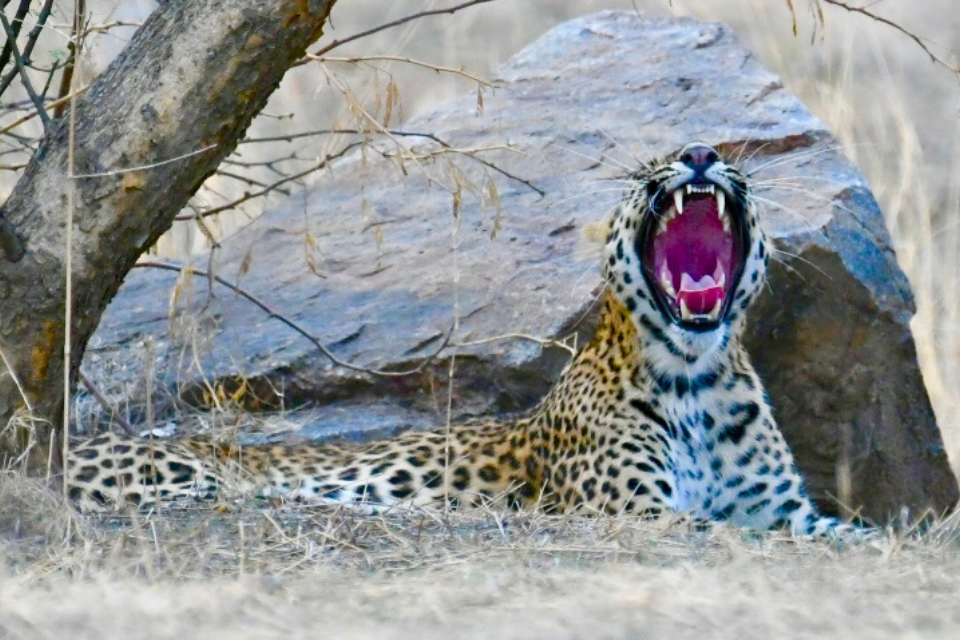
Vision is important, but the world of Leopard Behavior Jhalana is built on scent. One of the most misunderstood behaviors is the “grimace.”
The Chemical Internet
If you see a leopard pause, sniff a bush, and curl its upper lip back, it is performing the Flehmen Response. It is drawing scent molecules into the Jacobson’s Organ to analyze pheromones. In the high-density world of Leopard Behavior Jhalana, this “chemical internet” is how they avoid conflict and find mates without direct contact.
8. Reading the Signs: The Language of Alarm
A master tracker doesn’t look for the leopard; they look at the jungle. To understand Leopard Behavior Jhalana, you must learn the language of the alarm calls.
- Langur Monkey (High Certainty): A sharp, hacking “Khok-Khok.” This usually means the leopard is visible and moving on the ground.
- Sambar Deer (Absolute Certainty): A metallic “Ponk.” The Sambar rarely calls unless the threat is imminent, making it the most reliable indicator of active Leopard Behavior Jhalana.
- Peacock (Moderate Certainty): A loud, frantic honking. While often accurate, peacocks are jumpy and can falsely alarm for snakes or mongooses.
9. Nocturnal Leopard Behavior Jhalana: The Urban Patrol
While safaris are diurnal, the most fascinating Leopard Behavior Jhalana happens at night.
Using City Lights to Hunt
Radio-collaring data has revealed that Leopard Behavior Jhalana includes patrolling the city periphery. Dominant males often sit on the ridges overlooking Jaipur. This is a territorial behavior, but also a hunting strategy. They use the ambient light of the city to silhouette prey animals against the urban glow, turning the city’s light pollution into a tactical advantage—a stunning example of adaptation in Leopard Behavior Jhalana.
10. Conclusion: Decoding Leopard Behavior Jhalana
Mastering the nuances of Leopard Behavior Jhalana transforms your safari. It allows you to see the forest not just as a collection of trees, but as a theater of survival.
When you bring your curiosity to Jaipur in 2026, look for the scratch marks on the Dhok trees. Listen for the sawing in the valley. Watch the tail of the Langur. By understanding the “Glass Wall,” the territorial scrapes, and the vertical hunts, you become a witness to the incredible resilience of nature. You begin to truly see Leopard Behavior Jhalana for what it is: a masterclass in urban survival.
11. FAQ: Common Questions About Leopard Behavior Jhalana
1. Why do leopards in Jhalana seem smaller than African leopards?
A. While they are the same species, the Indian subspecies (Panthera pardus fusca) is generally more compact. Leopard Behavior has favored a leaner, more muscular build adapted for rock climbing and navigating the narrow crevices of the Aravallis, rather than the heavy bulk needed for open savannah wrestling.
2. Do leopards in Jhalana eat humans?
A. No. Despite the high density of predators and proximity to Jaipur, there are no recorded cases of man-eating in the reserve’s recent history. A defining trait of Leopard Behavior Jhalana is “conflict avoidance.” The abundance of natural prey (Blue Bulls, Peafowl) and stray dogs keeps them well-fed, allowing them to coexist peacefully alongside human settlements.
3. Why do I see leopards rolling on the ground?
A. If you witness this, you are seeing a key part of olfactory Leopard Behavior, Jhalana. This is often “scent rolling.” The leopard is likely rolling in the urine of a potential mate to analyze pheromones, or rolling in dung/earth to mask its own scent, which acts as a form of olfactory camouflage during a hunt.
4. What does a “Tail Flick” mean?
A. Reading body language is crucial to understanding Leopard Behavior, Jhalana. If a leopard is lying down but the white tip of its tail is flicking rhythmically (like a metronome), it is agitated or in hunting mode. It is not relaxed. This is a critical signal for photographers to prepare, as a burst of action is likely imminent.
Disclaimer
Jhalana is a wild ecosystem, not a zoo; sightings are never guaranteed. For your safety, strictly remain inside the vehicle at all times and follow the naturalist’s instructions. The author and operators are not liable for the unpredictability of nature.