- October 4, 2025
How to Photograph Leopards at Dusk: Settings, Spots & Ethics at Jhalana
TL;DR (read this before you roll out)
- Golden rule: Prioritize distance and calm—no baiting, no playback, no flash.
- Best light: The hour before sunset to ~15 minutes after; expect fast-changing exposure.
- Baseline settings: Start 1/800–1/1000s, f/4–f/5.6, Auto ISO capped at 6400–12,800 (full-frame) or 3200–6400 (APS-C); AF-C + subject/animal detect; wide-to-zone AF; burst high.
- Vehicle technique: Use a beanbag on the door/roll bar, engine off, and communicate with your driver for gentle positioning.
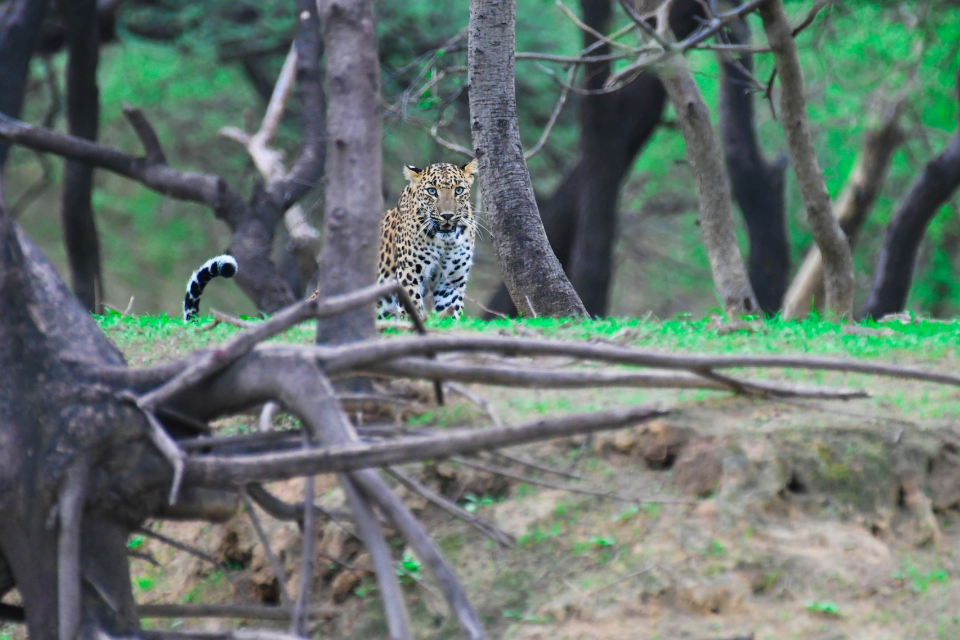
- Spots: Focus on rocky outcrops, scrub edges, nullahs, waterholes, and jeep tracks with fresh pugmarks—where dusk activity spikes.
- Ethics: Minimum 30–50 m if possible; let the leopard choose the distance; never block paths or crowd with vehicles.
Why Jhalana at Dusk Works So Well
Jhalana’s compact, scrub-forest habitat and rocky hillocks create natural funnels for leopard movement. As temperatures drop toward evening, leopards often transition from day beds in thickets toward edge habitats: the interface of rocks, trails, and shallow nullahs. You’re betting on predictable movement windows in unpredictable light—that’s where skill with exposure, autofocus, and vehicle craft pays off.
Behavioral cues to watch:
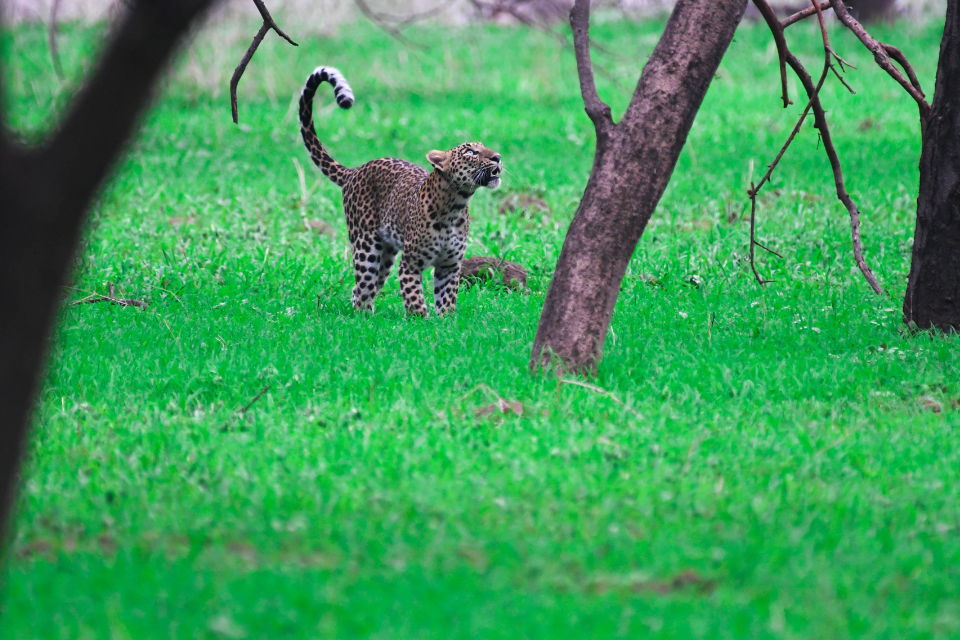
- Head-up scanning from rocks or termite mounds just before last light.
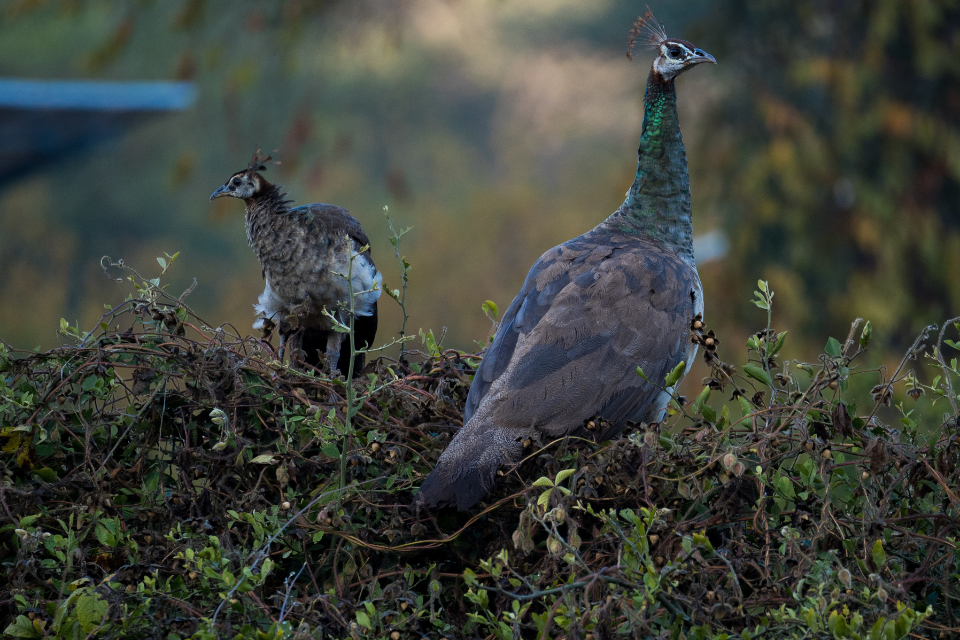
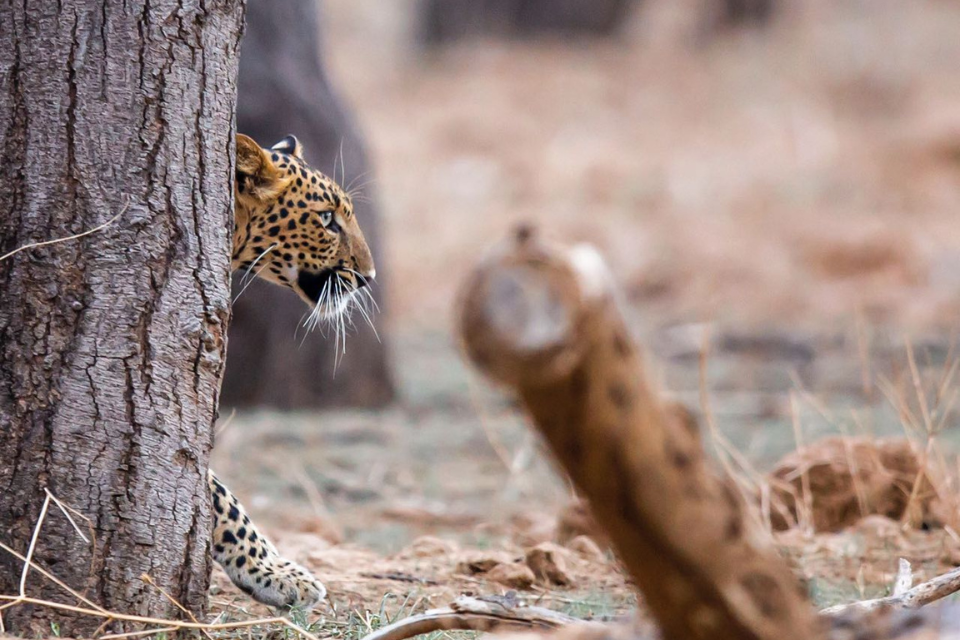
- Trail crossings at scrub edges; listen for alarm calls (peafowl, langur, sambar).
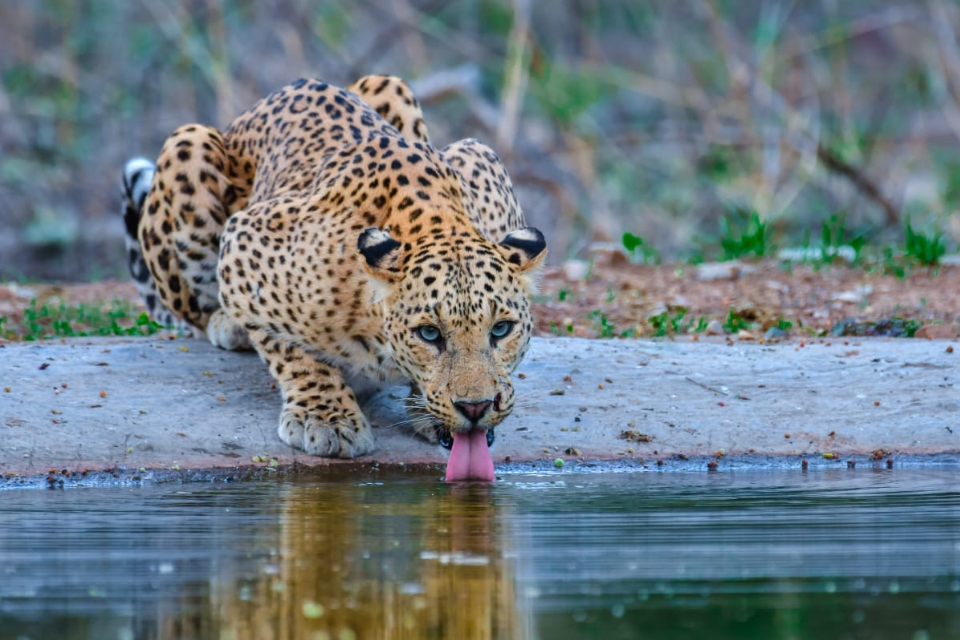
- Waterhole checks on warmer evenings.
The Gear That Actually Helps (and what to leave behind)
Bodies: Modern mirrorless bodies with fast AF in low light and good high-ISO behavior excel, but a capable DSLR still works if you nail technique.
Lenses:
- Primary: 100–400mm, 200–500mm, 150–600mm.
- Fast telephoto: 300/2.8, 400/2.8, 500/4 for blue-hour; add a TC only if light allows.
- Secondary: A short zoom (24–70) for habitat/scenic silhouettes.
Supports & accessories:
- Beanbag for Gypsy/Bolero doors/rails; pre-fill to a medium pack—too hard transmits vibration, too soft sags.
- Thin kneeling pad or folded jacket for quick height changes.
- Lens coat & rain cover (dust/rain).
- Two cards + spare battery easily accessible; don’t dig when it happens.
- Polarizer? Skip at dusk; it costs light.
- Flash? Don’t. It’s intrusive and often prohibited.
Camera Settings for Jhalana at Dusk (Recipes You Can Trust)
These recipes assume shooting from a vehicle (Gypsy/Bolero) using a beanbag. Adapt based on your body’s noise tolerance.
1) Early Dusk (Golden Hour: ~60–20 minutes before sunset)
Subject: walking leopard in scrub / on rocks
- Shutter: 1/1000s (moving) or 1/640s (slower pace)
- Aperture: f/5.6 (zoom wide open) or f/4 on fast primes
- ISO: Auto ISO with cap at 6400 (FF) / 3200 (APS-C)
- Metering: Matrix/Evaluative; dial –0.3 EV if backlighted rim is blowing highlights; otherwise 0 EV
- AF: AF-C (Continuous) + Subject/Animal Detect ON; Zone/Wide box; back-button focus preferred
- Drive: High-speed burst (but time your bursts—don’t spray the entire sighting)
- Stabilization: IBIS/VR/IS ON; if shutter ≥ 1/1000s you can leave it ON; it won’t hurt
- White balance: Auto WB; shoot RAW
Static portrait on rock (early dusk):
- 1/500–1/800s, f/4–f/5.6, Auto ISO capped as above; +0.3 EV if fur is too dark against bright sky.
2) Late Dusk (Blue Hour: ~20 minutes before sunset to ~15 minutes after)
Light falls off fast; you must choose noise over blur.
Leopard walking/crossing track:
- Shutter: 1/800s (non-negotiable if you want crisp paws)
- Aperture: wide open (f/2.8–f/5.6; whatever your lens gives)
- ISO caps: 12,800–25,600 (FF) / 6400–12,800 (APS-C) if your denoise workflow can handle it
- AF: AF-C + expanded zone (contrast is lower); Animal Eye detect if reliable, else Tracking on the face/shoulders
- Exposure: Start at 0 EV, check zebra/histogram, then bias –0.3 to –0.7 EV to protect bright sky strips; lift shadows in post
Static silhouette on skyline:
- Shutter: 1/500s
- Aperture: f/4–f/5.6
- Exposure: –1.0 EV for punchy silhouette; compose with clean contours (no intersecting scrub).
Panning (only if abundant light left):
Drop to 1/60–1/125s, AF-C, IS/VR Mode 2 (panning), follow smoothly; expect a low keeper rate but high reward.
Auto ISO & Minimum Shutter: Set It Once, Then Drive
- Enable Auto ISO with Minimum Shutter behavior tied to focal length.
- For moving subjects, override with a manual minimum (e.g., 1/800s).
- In M mode + Auto ISO, ride Aperture and Shutter creatively while the camera floats ISO within your cap.
- Watch the histogram; “Expose to the right” carefully without clipping sky highlights.
AF Modes That Actually Work on Leopards
- AF-C + Animal/Eye Detect (Mirrorless): excellent when contrast allows; switch to Tracking if the system is hunting.
- AF area: Wide/Zone to acquire fast, then Tracking to stay locked while the cat weaves through brush.
- DSLR users: AF-C, Group/Expanded points; aim for head/shoulders; re-acquire quickly if grass confuses the AF.
- Back-button focus avoids refocus when you half-press to recompose.
Composition in Fading Light
- Clean backgrounds: Shift the vehicle laterally a meter or two to separate the cat from busy scrub.
- Rim light: Position for backlight at golden hour; expose for highlights and let shadows fall moody.
- Eye height: If safe and permitted, drop your camera lower (without leaning out dangerously) to approach eye-level drama.
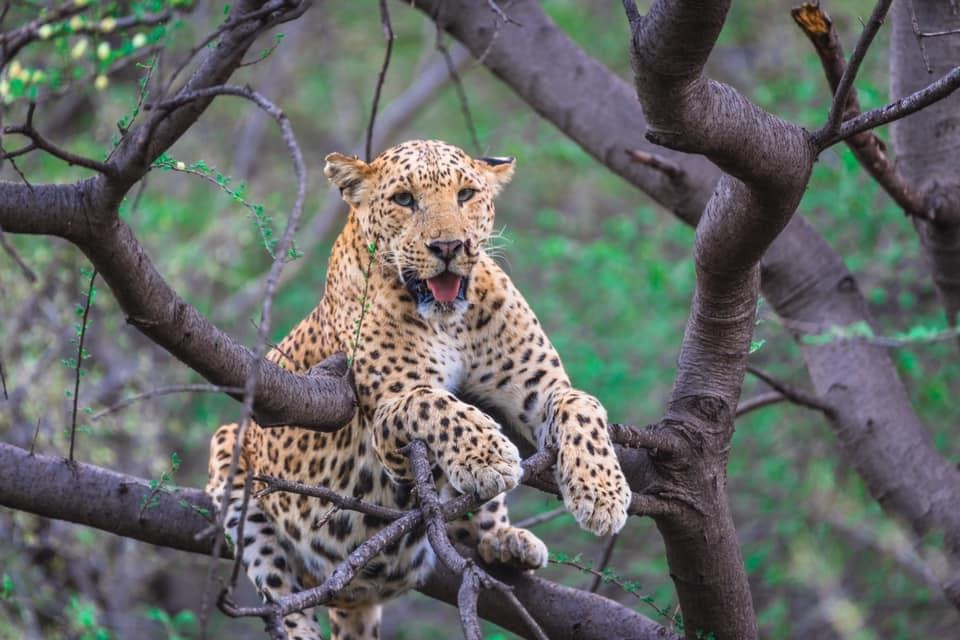
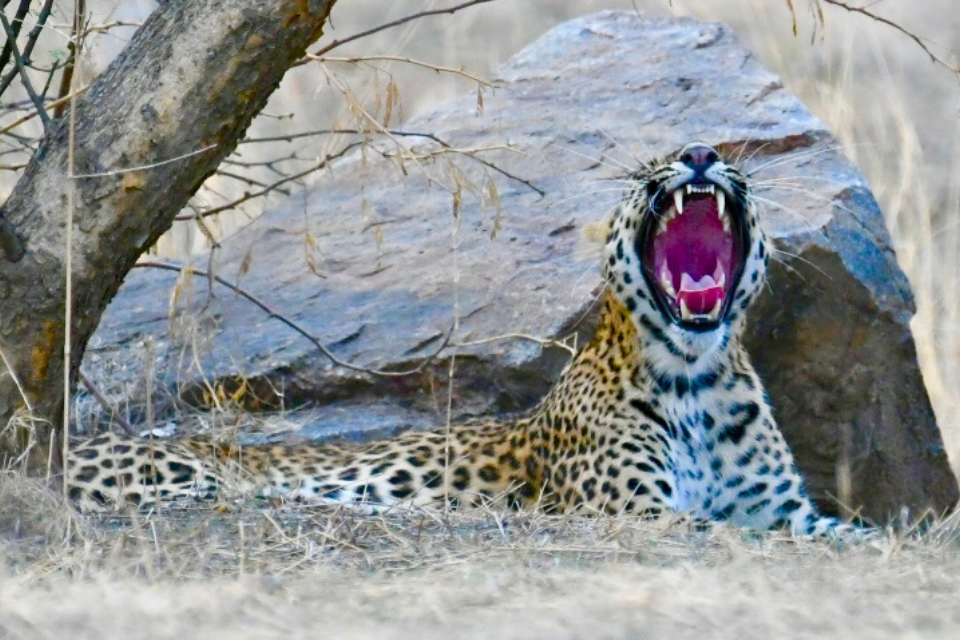
- Behavior beats pose: yawns, head turns, tail curls at track crossings—anticipate, don’t chase.
Where to Look Inside Jhalana (Without Spoiling the Chase)
Rather than naming micro-locations (which change as leopards shift territories), think habitat pockets and signs:
- Rocky outcrops & hillocks that catch last light—good for silhouettes and scanning cats.
- Scrub-edge tracks (Prosopis, Ziziphus) where prey trails converge.
- Nullahs and waterholes—especially on warmer evenings.
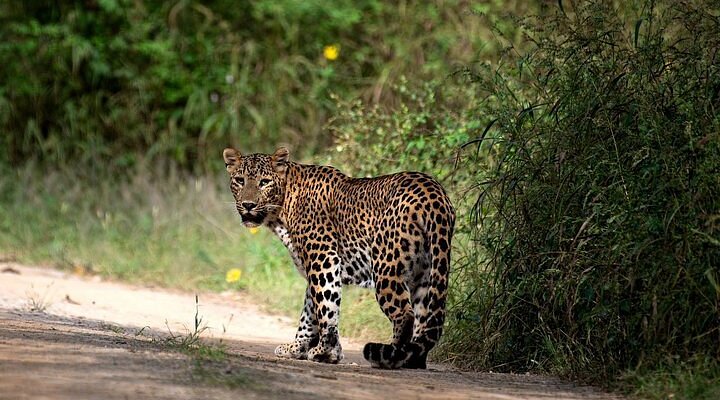
- Fresh sign: pugmarks on sandy patches, spray markings on low branches, alarm calls ahead of you.
- Decision points: T-junctions on jeep tracks—hold your position at angles, don’t block.
Pro tip: Ask your driver to idle 50–60 m away when you first arrive, engine off, scan, then reposition incrementally. Sudden lunges cost you the sighting.
Gypsy/Bolero Technique: Beanbags, Vibration & People Management
- Beanbag placement: Door top or roll bar; settle the lens for a second before shooting to let vibrations die.
- Engine discipline: Engine off for every serious burst. A running diesel at 1/80–1/500s is micro-blur city.
- Elbows & body: Tuck elbows, lean gently into the door for a single mass with the vehicle; don’t hover.
- Height changes: Rotate the lens foot vertically on the beanbag rather than lifting the whole rig.
- Passenger choreography: Agree hand signals and quiet movement rules; one photographer at a time per side to keep the vehicle stable.
- Shooting 2nd row: Use a low-profile beanbag or folded jacket on the roll bar; mind the arc of the person in front.
Monopods? Useful only on long waits; in a moving vehicle, beanbag wins for speed.

Ethics & Safe Distances (Non-Negotiable)
- Distance: Aim for 30–50 m; closer only if the leopard chooses to approach calmly. If it stares/flicks tail/huffs—back off.
- No flash, no spotlights, no calls/playback.
- Don’t crowd or box in with vehicles. Leave a clear exit corridor.
- Silence phones, keep voices low; no standing or leaning far out if it changes the cat’s behavior.
- Never request drivers to break rules or cut tracks to “get closer.” Your image isn’t worth a stressed or displaced leopard.
Seasonal & Weather Nuance
- Winter: Cleaner air, cooler cats—longer movement windows; carry a light layer and fingerless gloves for dexterity.
- Summer: Heat shimmer after 5 pm; double-check sharpness at longer focal lengths; waterholes more promising.
- Monsoon & post-monsoon: Moody skies and saturated greens; keep a rain cover handy and wipe the front element often.
File Handling & Post-Processing for High ISO
- RAW only. Enable lossless compressed if available.
- Noise strategy: Prefer luminance NR in a good RAW converter + a dedicated denoiser (when needed) after basic tonal work.
- Color: Push warm tones slightly for golden hour; keep blues controlled in late dusk so fur stays natural.
- Local contrast: Use subtle micro-contrast on eyes/whiskers; avoid crunchy fur.
- Crop discipline: Jhalana cats can be close; compose in camera to reduce heavy crops that amplify noise.
On Permits, Time Slots & Guides
Rules and slot structures can change. Book with authorized operators, respect your guide’s instructions, and arrive early to settle the vehicle and brief your team on movement and silence. If you’re comparing operators, ask about group size, driver’s wildlife etiquette, and photography orientation.
Responsible Booking (and why with us)
We prioritize ethical distance, calm vehicle craft, and photographer-friendly timing. If you prefer, we’ll pair you with drivers who understand beanbag setups, engine discipline, and non-crowding protocols.
👉 Book through our website for curated dusk slots, guide matching, and last-minute weather/visibility intel so you don’t waste a precious evening.
FAQ: Jhalana Leopard Photography at Dusk
1) What’s the single most important setting at dusk?
Shutter speed. Start around 1/800–1/1000s for moving leopards and let ISO rise; blur kills more shots than noise.
2) Should I use Auto ISO?
Yes. Pair M mode with Auto ISO and a sensible cap (FF 6400–12,800; APS-C 3200–6400+). Set a minimum shutter to avoid dips.
3) Is animal eye-AF reliable in scrub?
Often, but not always at last light. Be ready to switch to Tracking or Zone and aim for the head/shoulders mass.
4) Do I need a tripod or monopod in the jeep?
Generally no. A beanbag is faster, quieter, and steadier in vehicles.
5) Can I use flash or a spotlight?
No. It’s intrusive and typically against guidelines. Learn to embrace high ISO and careful exposure.
6) How close is “too close”?
If the leopard changes behavior—stares, tail flick, growl—you’re already too close. Keep 30–50 m and never block an exit.
7) Prime vs zoom at dusk?
A fast prime helps in late dusk but is less flexible for composition in a vehicle. If you carry one, keep a zoom mounted on the second body.
8) Best seats in a Gypsy/Bolero?
Front left/right for door support and quick angles; second row works with a low beanbag on the roll bar—coordinate movements.
9) Should IBIS/VR be ON?
Yes, especially below 1/1000s. Turn panning mode on if you deliberately pan.
10) What if dust wrecks contrast?
Move the vehicle slightly upwind if possible, or shift lateral angle to clean the background; add micro-contrast later, not in-camera.
Final Take
Mastering dusk in Jhalana is about owning the variables you can control—shutter, AF, vehicle craft, and ethics—and gracefully accepting the ones you can’t (a wild cat’s choices). Keep distance, keep calm, and let the leopard write the script while you handle the light.
Disclaimer All images used in this blog are either sourced from public domain or credited to their respective owners. If you are the copyright holder of any image and wish to request its removal or proper attribution, please contact us at [email protected]